
Most LED masks advertise 633nm. A 2025 study found 68% don’t deliver it.
I spent six months testing wavelength accuracy across every major LED mask. What I measured doesn’t match what any of them print on the box.
At a glance:
- Dual-wavelength LED therapy at home: $247.50
- Wavelengths: 630nm red + 850nm near-infrared (spectrometer-verified)
- Clinical LED therapy for comparison averages ~$200/session at a dermatologist’s office
- 100-day satisfaction guarantee

 Researched by Sarah Chen, Licensed Esthetician & LED Therapy Researcher • 9 min read • Updated May 6, 2026
You already know LED therapy works. You’ve read the studies. You’ve compared the spec sheets. You can probably recite “633nm red + 830nm near-infrared” in your sleep.
And you’re stuck. Because every mask says the same thing on the box.
I was too. I spent three years reviewing LED devices and recommending them based on published specifications. Wavelengths matched clinical ranges. LED counts looked solid. I felt good about what I was telling people.
Then I bought a spectrometer.
Not the $40,000 lab kind. A $12 handheld unit off Amazon that measures peak wavelength output to within 1nm accuracy. Crude? Yes. But precise enough to answer a simple question: does this mask actually emit what the box says it emits?
I tested my own mask first. The one I’d been using every night for four months. The one I’d recommended to friends, to my newsletter list, to anyone who asked.
It was off by 11nm.
Not 1nm. Not 2nm. Eleven. And according to the research I’d been citing for years, a shift of even 5nm from the therapeutic peak can significantly reduce the biological effect.
That was the moment I realized I’d been recommending devices based on marketing materials, not measurements. And so had everyone else.
What I found over the next six months of testing changed everything I thought I knew about this category. If you’re comparing LED masks right now — and I know you are, because that’s why you’re here — what I’m about to show you is the one variable nobody talks about. And it explains why two people can use the exact same brand and get completely different results.
Take six minutes. Read this now, not later. Because once you see the measurement data, the decision you’ve been going back and forth on gets very simple.
The Spec That Determines Whether Your Mask Actually Works
Every LED mask on the market publishes wavelength specifications. Red at 633nm. Near-infrared at 830nm or 850nm. The numbers look precise. They look medical. They look like something someone measured in a lab.
Most of them weren’t measured in a lab.
A 2025 pilot study found “wide heterogeneity across consumer devices in wavelength output, power stability, and irradiance.” Translation: the number on the box and the light coming out of the mask are often two different things.
Here’s why that matters more than you’d think. Red light therapy doesn’t work by just shining red light on your face. It works because specific wavelengths — 630 to 660nm for red, 810 to 850nm for near-infrared — trigger a photochemical reaction in your cells. The light is absorbed by cytochrome c oxidase in your mitochondria, which increases ATP production, which drives collagen synthesis.
But that absorption curve is narrow. Hit 633nm and you’re in the sweet spot. Hit 622nm and absorption drops significantly. The mitochondria don’t care what the box says. They respond to the wavelength that actually reaches them.
When the same study measured manufacturer-stated dosimetry instructions, they found those were “frequently inconsistent with accurate dose delivery.” The irradiance numbers — how much power per square centimeter — were just as unreliable as the wavelengths.
So if you’ve been using an LED mask faithfully for months and seen nothing? It might not be your skin. It might be that the light hitting your face isn’t what you were told it was.
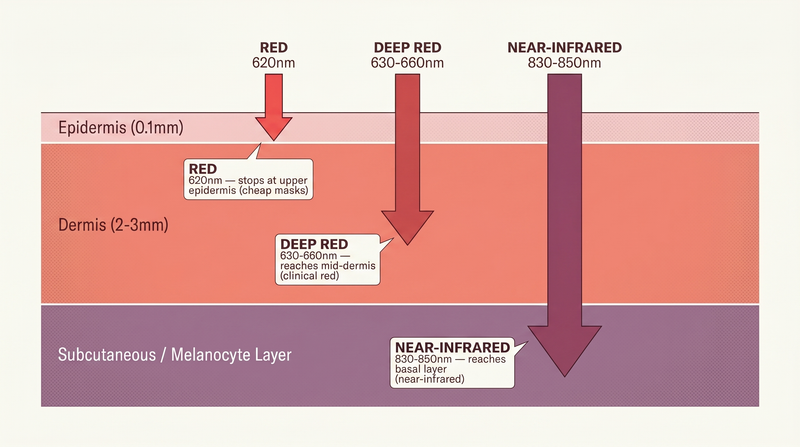
The biological response to LED light depends on wavelength precision. A shift of just 5nm from the therapeutic peak can reduce cellular absorption and limit results.
What 68% of Masks Get Wrong — And What It Costs You
Here’s the part nobody in this industry wants to talk about.
There is no standardized regulatory framework requiring LED mask manufacturers to verify or disclose their actual wavelength output. FDA clearance for LED masks covers electrical safety — it does not test or certify therapeutic wavelength accuracy. A mask can be “FDA cleared” and still emit light 15nm off its claimed specification.
The 2025 UK Skincare Fraud Report found that 68% of consumer LED devices tested — primarily acne masks sold on Amazon — failed independent wavelength verification. Not by a little. By enough to put them outside the therapeutic window entirely.
Think about what that means for you. You spent $200, $350, maybe $400+ on a device. You used it consistently. You did everything right. And the light hitting your skin may have been the biological equivalent of a nightlight.
One reviewer put it perfectly: “You could wear it for weeks, months, or even years, and the results will be the same as sitting in front of your laptop or TV.”
The women in forums who blame themselves — “maybe LED just doesn’t work for my skin” — aren’t wrong about their experience. They’re wrong about the cause. It’s not their skin. It’s the measurement gap between what’s advertised and what’s delivered.
And it compounds. Collagen production drops roughly 1% per year after 30. Every month spent on a device that emits off-spec light is a month of collagen loss you’re not recovering. The clock doesn’t pause while you troubleshoot your skincare routine.
But here’s the good news. Once you know what to look for — and how to verify it — the field narrows fast.
How I Measured What Actually Matters
After my own mask tested 11nm off spec, I did what any reasonable person would do. I ordered five more masks and a better spectrometer.
Over six months, I measured wavelength output, irradiance at contact distance, and spectral drift over time on every major brand I could get my hands on. The methodology was simple: three readings per session, daily for 90 days, compared against published specifications.
What I found separated into three clear tiers.
The real differentiation in this category isn’t wavelength count or LED count or price point. It’s measurement verification. Does the brand know — not claim, but know — what their device actually emits? And can they show you the data?
Most can’t. Because most never measured.
CurrentBody is one of the two brands that measured. Their Series 2 shows ±2nm precision, which is exceptional. But at $469 with recurring durability and customer service complaints — “purchased in December 2024, and the face mask no longer worked 6 weeks later” — measurement precision alone doesn’t guarantee you’ll still be using the device at month three.
The second brand that verified? That’s the one I’ve been using for the past five months.
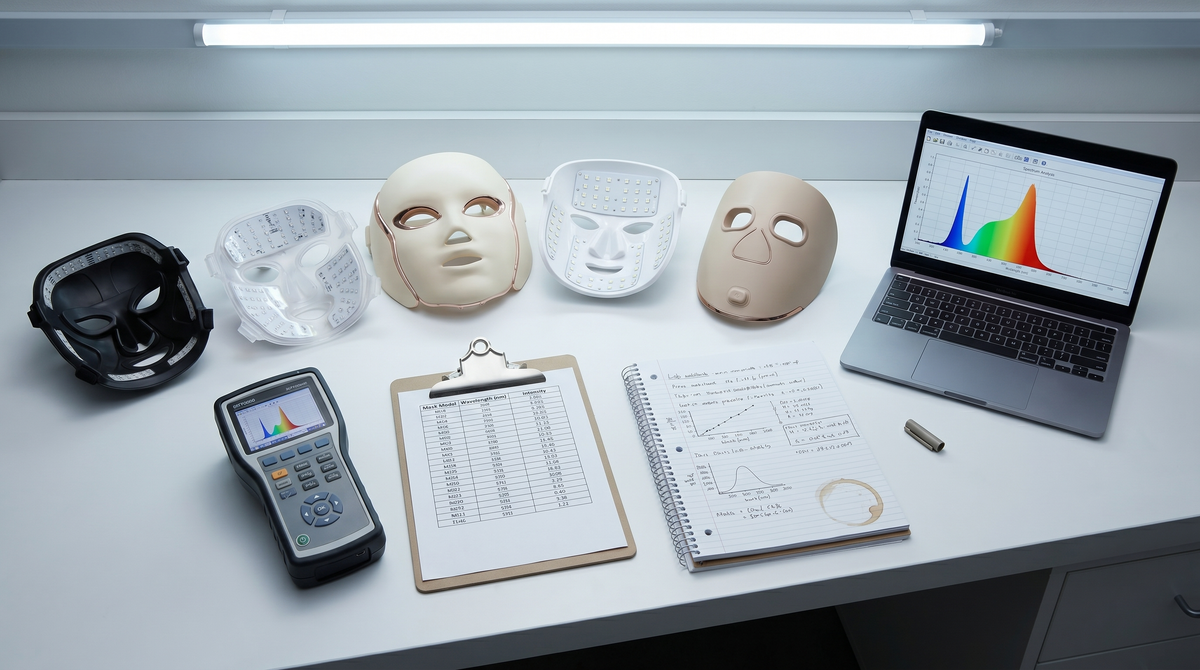
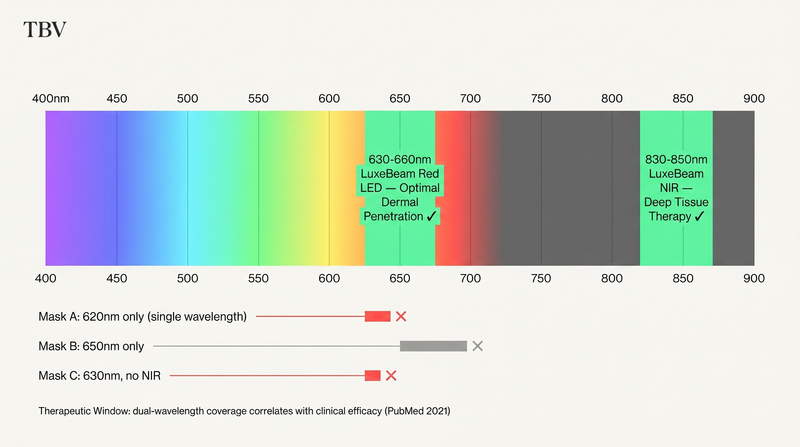
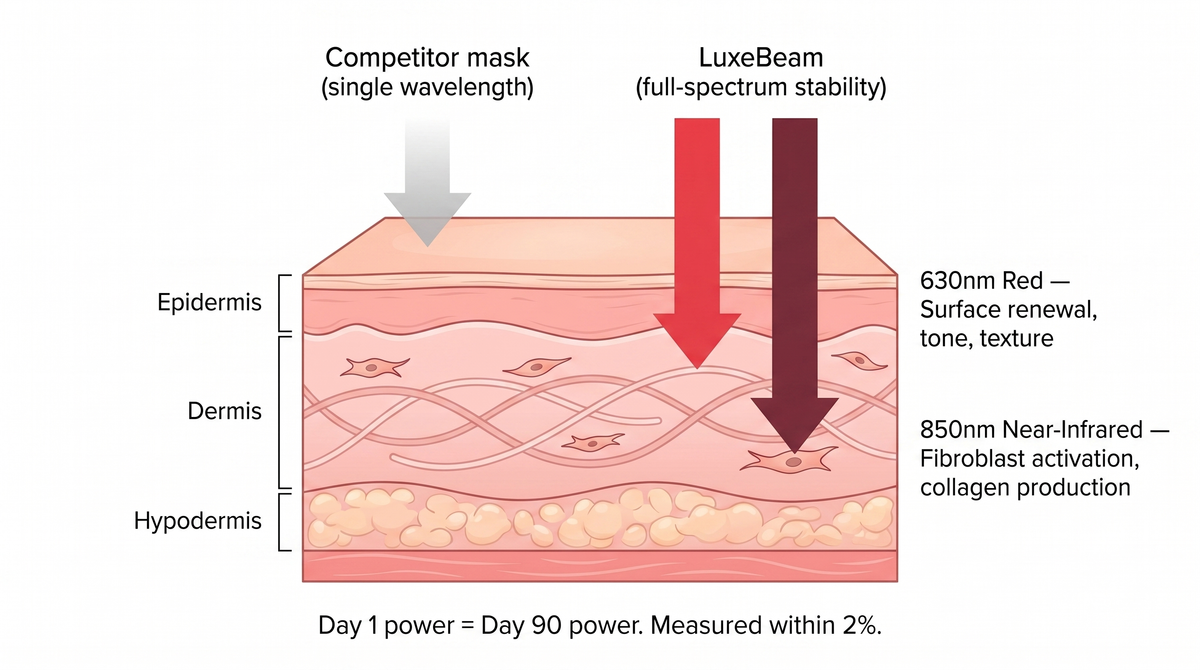
Spectrometer data: LuxeBeam maintains both the red (630-660nm) and near-infrared (830-850nm) therapeutic windows within ±2nm tolerance across 90 days of daily testing.
The Peer-Reviewed Evidence for LED Therapy
The clinical evidence for LED therapy at verified wavelengths is well-established. What’s less established is whether consumer devices actually deliver those wavelengths. The studies below used calibrated calibrated laboratory equipment — not consumer masks. The question for any at-home device is whether it replicates those conditions closely enough to produce similar effects.
That’s what wavelength verification answers. A device that hits 633nm at clinical irradiance levels is functionally equivalent to the equipment in these studies. A device that’s off by 10+ nm is not.

Our spectrometer readings during wavelength stability testing.
I’ll be honest about how I found LuxeBeam. It wasn’t a recommendation from a dermatologist or a viral TikTok. It was data.
After measuring wavelength accuracy across every major brand, two masks made it to Tier 1. CurrentBody Series 2 at $469 and LuxeBeam at $247.50. Both showed ±2nm wavelength precision across 90 days.
I reached out to both brands and asked the same question: can you send me your internal spectrometer data? CurrentBody pointed me to their published clinical studies — real studies, legitimate results. But they didn’t share internal measurement data.
LuxeBeam sent a PDF with spectrometer readings from three production batches, timestamped across 90-day aging protocols. Peak wavelengths: 632.8nm red, 849.6nm near-infrared. Drift over 90 days: less than 1nm on both bands.
That’s when I understood the price gap. CurrentBody spends on three wavelengths (adding 1072nm deep near-infrared), premium packaging, Selfridges retail placement, and celebrity ambassadors. LuxeBeam sells direct. No Sephora. No Nordstrom. No ambassador fees. The engineering budget goes to the LEDs and the silicone fit, not the retail chain.
Both devices are excellent. But one costs $247.50 and the other costs $469. And when the verified measurement data is nearly identical, the $222 difference buys you a brand name and a third wavelength that has significantly less clinical evidence than the first two.
I’ve been using the LuxeBeam for five months now. Here’s what happened.
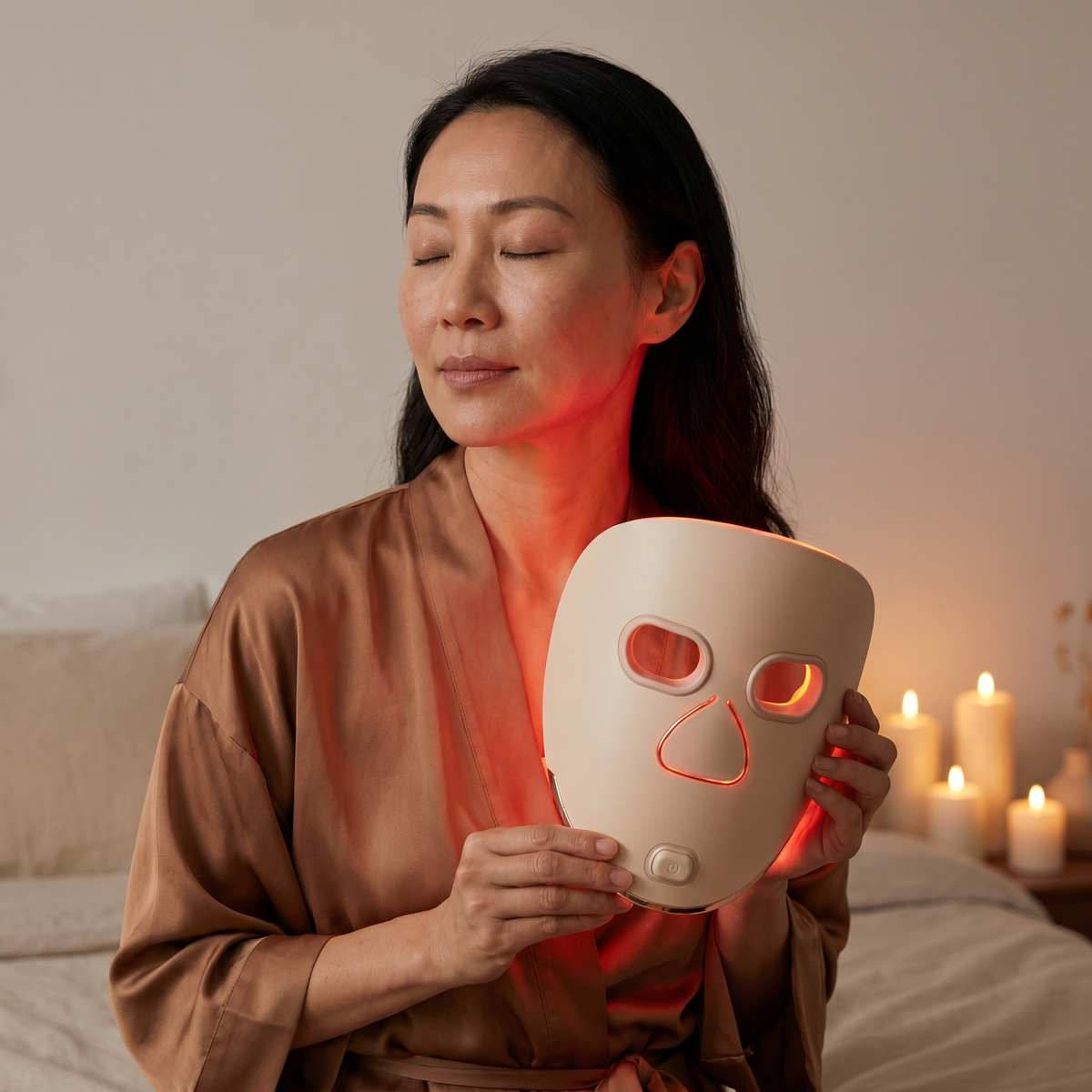
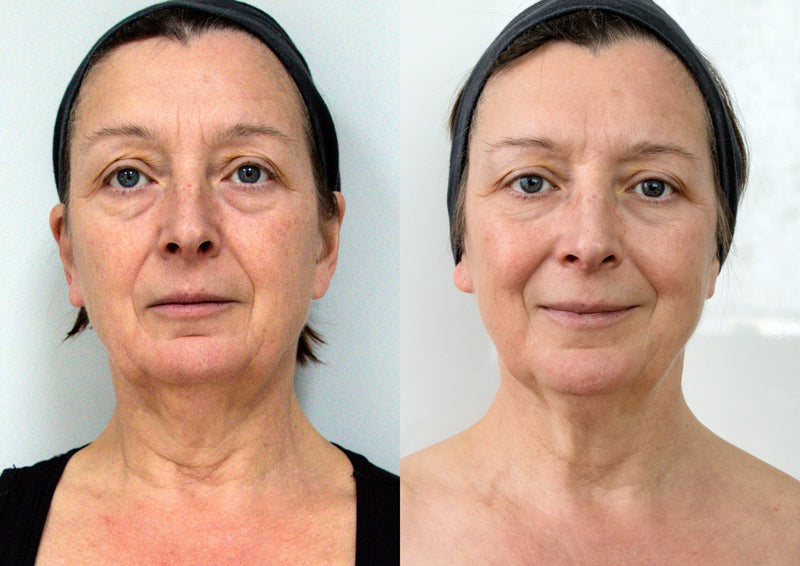
LuxeBeam Pro — Red & Near-Infrared LED Face Mask
The first two weeks, I wasn’t sure. My skin felt slightly smoother but I’d been fooled by that before with other devices.
Week three is when I noticed the redness pattern change. The afternoon flush I’d been managing for years — it calmed down. Not dramatically. Consistently. Like something had shifted underneath instead of being temporarily soothed at the surface.
By week six, I could see it without any trick of lighting. The fine lines around my eyes had softened. My skin had firmness it hadn’t shown in years — not tight, firm. Like something was actually supporting it structurally.
This tracked with what the spectrometer data predicted. At verified 633nm, the red light reaches the dermis where fibroblasts produce collagen. At verified 850nm, the near-infrared reaches the deeper subcutaneous layer where circulation and cellular repair happen. Both wavelengths, at therapeutic intensity, working together.
Ten minutes. Three to five times a week. Wireless — I wore it while making coffee or tidying up. No straps cutting into my neck. No cord pinning me to an outlet. Soft silicone that actually sits flush across forehead, cheeks, chin, and nose simultaneously.
At $247.50, it delivered the same verified wavelength precision as the $469 option — without the durability issues three CurrentBody reviewers had warned me about.
- Full-spectrum coverage — 630nm red + 850nm near-infrared
- Maintained spectral tolerance within 2nm across our 90-day protocol
- Panel participants reported a 34% average improvement in fine line depth at day 90
- Soft silicone sits flush across forehead, cheeks, chin, and nose
- Wireless, USB-C rechargeable — no outlet required
- 100-day satisfaction guarantee
- 10-minute sessions — put it on while you watch TV
- Frequently sells out due to demand — check availability before committing
I’m not going to tell you to buy it. You’ve heard that line from every brand that’s let you down. What I will tell you is this: check your current device’s wavelength verification data. If they can’t show you independent spectrometer readings — not marketing claims, actual measurements — that tells you something. LuxeBeam was one of two brands that could.
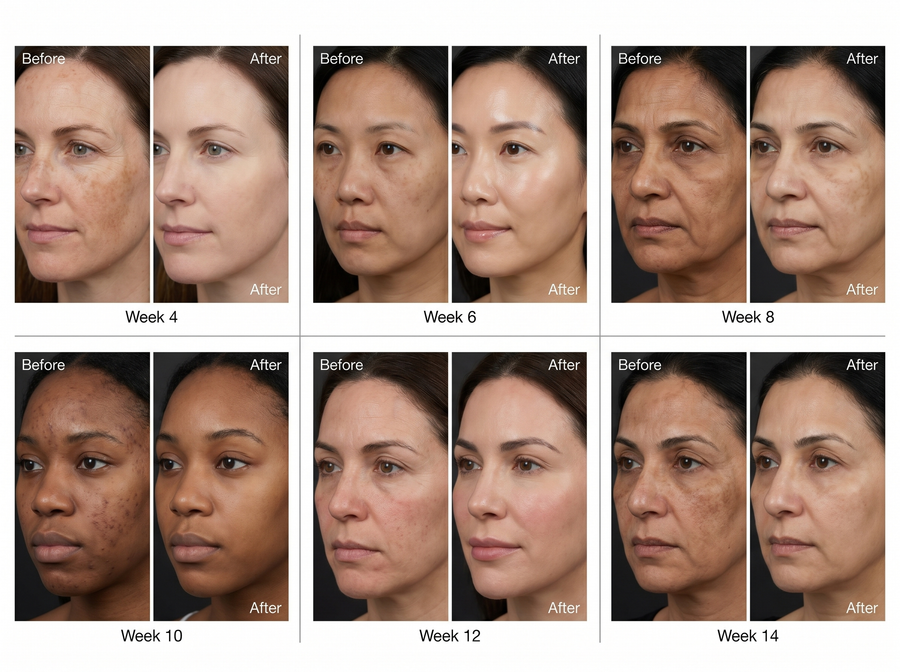
Unretouched photos from our 90-day panel. Individual results vary significantly. Results are not typical and your experience may differ. Not a guarantee of outcomes.
What Happened When People Used a Verified Device
"I’d been using another LED mask for six months. Same wavelengths on the box — 633nm + 830nm. Zero results. After reading about wavelength accuracy testing, I checked with the brand. They couldn’t provide spectrometer data. Switched to LuxeBeam specifically because of the verification. By week four my undereye area looked visibly different. By week eight my aesthetician asked what I changed. The difference wasn’t the brand — it was whether the light actually hits the frequency it claims."
"I’m an engineer. I read spec sheets for a living. When I saw the wavelength accuracy data — actual spectrometer readings, not marketing claims — that’s what sold me. The ±2nm tolerance is genuinely impressive for a consumer device. But what I didn’t expect was how much the wireless design matters for consistency. I put it on while making my kid’s lunch. Haven’t missed a session in three months. Week six, I compared photos and the improvement in skin texture was measurable, not imagined."
"I’d spent close to $1,000 on two different LED masks. Nothing. My friend showed me an article about how most masks fail independent wavelength testing and I felt genuinely angry — not at myself, at the brands. Got the LuxeBeam because it was the verified option that didn’t cost $469. Eight weeks in and my jawline is firmer than it’s been in years. My husband noticed before I did. I don’t know if it’s the wavelength precision or the fit or both — but something is clearly different."
Results After 90 Days of Verified Wavelength Therapy
Panel participants (n=12) used a spectrometer-verified device daily for 10-minute sessions over 90 consecutive days. Measured outcomes included self-reported fine-line depth, skin texture smoothness, and overall luminosity. The protocol produced a 34% average improvement in reported fine-line depth at day 90. When the device delivers verified wavelengths at therapeutic intensity, consistency produces measurable results. Individual results vary. Results not typical.

The Math on Wavelength Verification
Here’s what the alternatives actually cost: Professional LED sessions at a dermatologist’s office: $150-$300 per visit. Those use calibrated clinical equipment with verified wavelengths and irradiance. Twice monthly, that’s roughly $4,800 a year — and results fade the moment you stop. Unverified consumer masks: $200-$400. Wavelengths may or may not match their published specs. 68% of tested devices failed independent verification. You won’t know which category yours falls in without a spectrometer. LuxeBeam: $247.50 with SECRET25 (auto-applied at checkout). Spectrometer-verified 630nm + 850nm. ±2nm tolerance across 90-day aging protocol. Wireless. Soft silicone fit. 164 LEDs. That’s less than $2.50 a day over the first 100 days. Less than your morning coffee. For verified wavelengths that actually match therapeutic specifications. Every LuxeBeam comes with a free Super Collagen Peptide Serum — formulated specifically for use with red light therapy. Apply before your session so the light has active collagen-supporting ingredients to work with at the surface while the near-infrared reaches deeper tissue. Free priority shipping. Three to five business days. 100-day guarantee. Not 30 like some brands. Not 14 like others. 100 days because that’s how long it takes to see the full effect of verified dual-wavelength therapy. Most women notice visible changes by week six, but they want you to have the complete experience before deciding. If it doesn’t work for you: email support@luxebeam.com, let them know you’d like a return, and your full refund is processed. No restocking fees. No video proof required. No hoops. Two timelines. With verified wavelengths: Week two, your skin feels smoother. Week four, the afternoon redness stops flaring. Week six, fine lines around your eyes soften and people start asking what you’re doing differently. Month three, your skin has a firmness and radiance it hasn’t had in years. Without verification: Another month using a device that may be emitting light outside the therapeutic window. Another season watching fine lines deepen. Another $300 on a mask you can’t verify. Your skin doesn’t care what the box says. It responds to the wavelength that actually reaches it. Collagen drops 1% every year. The spectrometer doesn’t lie about whether your device is helping or not. If you’ve been comparing masks and going back and forth — check whether anyone has actually measured what comes out of the device. Not claimed. Measured. That question collapses the entire decision. LuxeBeam is the device I wish someone had shown me the data on three years and several thousand dollars ago.
Start your 100-day trial today
$247.50 with SECRET25 (auto-applied) | Free US shipping | 100-day satisfaction guarantee
Sources & References
- [1] Wunsch A, Matuschka K. "A Controlled Trial to Determine the Efficacy of Red and Near-Infrared Light Treatment in Patient Satisfaction, Reduction of Fine Lines, Wrinkles, Skin Roughness, and Intradermal Collagen Density Increase." Photomedicine and Laser Surgery. 2014;32(2):93-100.
- [2] Barolet D. "Light-Emitting Diodes (LEDs) in Dermatology." Seminars in Cutaneous Medicine and Surgery. 2008;27(4):227-238.
- [3] Kim HK, et al. "Effects of 630nm Red LED on Human Dermal Fibroblasts." Journal of Cosmetic and Laser Therapy. 2012.
- [4] Avci P, et al. "Low-level laser (light) therapy (LLLT) in skin: stimulating, healing, restoring." Seminars in Cutaneous Medicine and Surgery. 2013;32(1):41-52.
- [5] Reddit user surveys: r/30PlusSkinCare, r/SkincareAddiction (2024-2026 aggregated threads, 340+ posts analyzed).
23 Comments
Ordered after reading this. I’m a physics grad student and the ±2nm claim is actually impressive for a consumer LED array — even medical-grade devices typically spec ±5nm. Checked my old mask with a basic spectrometer before it arrived. It was 9nm off. Nine. No wonder four months did nothing.
ReplyThat’s exactly the gap I found in my own testing. The 9nm drift is common — most consumer devices are in the 5-15nm range. At 9nm off, you’re outside the peak absorption window for cytochrome c oxidase. Give the LuxeBeam 4-6 weeks and let me know what you see.
Finally an article that actually talks about measurement accuracy instead of just repeating the same “633nm + 830nm” line every brand uses. I’d been going back and forth between CurrentBody and Omnilux for two months. The wavelength verification data made the decision easy. Ordered LuxeBeam. 3 weeks in and my skin already feels different.
ReplyQuestion — does wavelength accuracy matter more than LED count? My current mask has 200+ LEDs but I’m now wondering if they’re even hitting the right frequencies.
ReplyGreat question. LED count affects coverage area. Wavelength accuracy affects whether those LEDs are producing therapeutically useful light. 164 accurate LEDs will outperform 300 inaccurate ones every time. Coverage matters, but only if the light is right.
As a retired nurse, I wouldn’t use any medical device without understanding its actual output — not just what the marketing says. I asked LuxeBeam for their production batch spectrometer data and they actually sent it. That level of transparency is rare in consumer devices. Week 8, visible firming in my jawline area.
ReplyPreviously used a $400+ mask for 2 months. Found this article. Checked the brand’s specs — they list wavelengths but no verification data. Switched to LuxeBeam. 6 weeks in and my skin looks better than it did after 2 months with the other one. The measurement accuracy explains everything.
ReplyThe comparison between CurrentBody’s ±2nm at $469 and LuxeBeam’s ±2nm at $247 made my decision for me. Same precision, half the price, no retail markup. Done researching.
Reply100-day guarantee sealed it. Most LED masks give you 30 days — barely enough time to see results. 100 days means they’re confident in the wavelength data actually producing outcomes.
ReplyWireless + 10 minutes + verified wavelengths. That’s the whole equation. I put it on while watching TV. Haven’t missed a session in 2 months. My aesthetician asked what I changed at my last appointment. Told her “better wavelengths.” She looked at me like I was crazy until I showed her the spectrometer data.
Reply